1 September 2026
COPYRIGHT, PERFORMERS’ RIGHTS: One More Try – George Michael’s estate sues over ‘lost’ footage
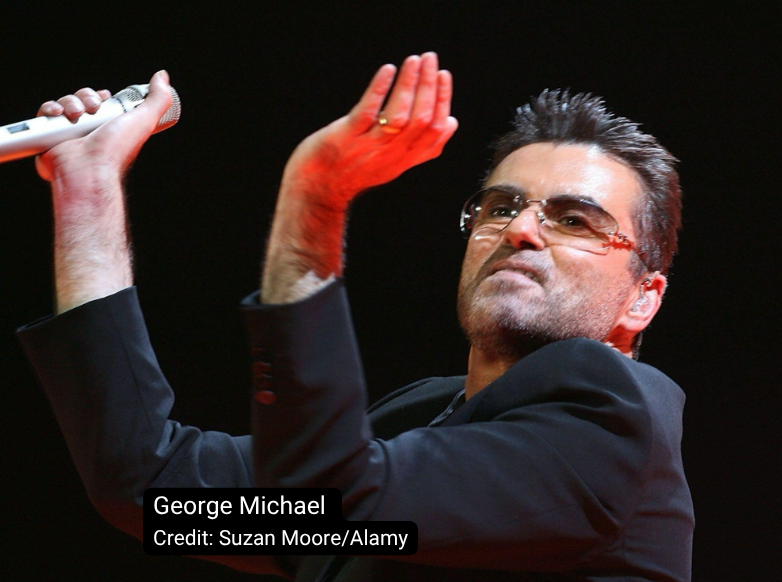
The estate of the late George Michael is seeking to prevent Andros Georgiou, one of Michael’s childhood friends, from selling rare footage of the pop star in the recording studio.
Robobuild Limited and Big Geoff Overseas Limited, companies associated with Michael and his music business, are bringing a claim against Georgiou and Tribe Media, Georgiou’s multimedia company.
Georgiou captured the footage using a camera given to him by Sony during Michael’s Faith tour. He later used it to film Michael recording Trojan Souls, an ambitious but ultimately unfinished album intended to feature a star-studded list of performers including Aretha Franklin, Janet Jackson, Sade and Elton John. Michael worked on the project until the death of his partner, Anselmo Feleppa, in March 1993.
A few years later, Michael and Georgiou fell out. Some of the material intended for Trojan Souls subsequently saw the light of day, with session tracks and footage appearing online. Georgiou has now brought the footage together into a single film, Trojan Souls – The Greatest Album That Was Never Made, with access to unreleased recordings reportedly being offered for a higher fee.
The companies associated with Michael are said to claim that their rights have been infringed. The Particulars of Claim do not appear to be publicly available, so the precise legal basis of the action remains unclear. However, the dispute potentially raises both copyright and performers’ rights issues.
There may be separate copyrights in the footage itself, the musical compositions and the sound recordings contained within it, potentially owned by different parties. Michael may also have had performers’ rights in his recorded performances, which provide separate protection against certain recording and exploitation of performances without consent. Importantly, ownership of the footage itself would not necessarily give its owner an unrestricted right to exploit copyright works or performances captured within it.
Consent may therefore prove important, as may the complex question of who owns which rights in material created more than 30 years ago.
In a statement given to The Sun, Georgiou said: “The film belongs to me. Trojan Souls belongs to me.”
Whether ownership of the film is enough to allow its commercial exploitation may now be for the court to decide.
DEFAMATION: Unfurling Responsibility for Libel – Forest Owner Sues Palace
Evangelos Marinakis, the owner of Nottingham Forest FC, has brought a libel claim against Crystal Palace FC and persons unknown responsible for displaying a banner by Palace supporters at Selhurst Park on 24 August 2025.
The banner showed Marinakis holding a gun to the head of one of Forest’s players, Morgan Gibbs-White, and said: “Mr Marinakis is not involved in blackmail, match-fixing, drug trafficking or corruption.” Marinakis has consistently denied any wrongdoing in relation to those allegations.
The general rule is that a person who participates in the publication of a libellous statement may potentially be sued. The responsibility of the “persons unknown” who produced or unfurled the banner is unlikely to be the most contentious aspect of the claim.
However, the fact that Marinakis has brought the claim against Palace as well raises an interesting question: when can a venue or organisation become legally responsible for defamatory material displayed by someone else?
At common law, a person who did not create defamatory material may, in some circumstances, become responsible for its continued publication by knowingly allowing it to remain on premises under their control. Palace was separately found by an FA Regulatory Commission to have breached FA rules requiring clubs to ensure that supporters do not behave in an improper, offensive, abusive, insulting or provocative way, and was fined £50,000. However, responsibility under FA rules does not necessarily make Palace a publisher for the purposes of defamation law. Whether Palace participated in, authorised or adopted the publication – or otherwise became responsible for its continued display – will be an important issue in the claim.
The case also brings into sharp relief the way courts approach meaning in defamation claims. The banner expressly said that Marinakis was not involved in the various allegations. Taken literally, the words would therefore convey no defamatory meaning.
But courts do not determine meaning by reading words in a vacuum. They consider what the ordinary reasonable reader would understand from the publication as a whole, including its context and any images. Here, the juxtaposition of the words with an image of Marinakis apparently holding a gun to Gibbs-White’s head could readily lead to an argument that the apparently exculpatory wording was intended – and understood – ironically.
Should the claim continue, the next step may include determination of preliminary issues such as meaning, before Palace files its substantive defence.
COURT REPORTING: In Plain Sight – HMCTS Bans Smart Glasses
His Majesty’s Courts and Tribunals Service (HMCTS) has banned Meta smart glasses from courts and tribunals in England and Wales, amid growing concerns about the ability of the technology to record discreetly – and even to facilitate covert communication during proceedings.
Those concerns are not merely theoretical. Earlier this year, a High Court judge found that a claimant had used smart glasses connected to his phone to receive assistance or coaching while being cross-examined. The judge noticed unusual pauses before his answers and interference around him. After the glasses were removed, a voice could be heard coming through his phone. The judge concluded that he had been “assisted or coached” in his replies and ultimately described his evidence as “unreliable and untruthful”.
The episode provides a striking illustration of why smart glasses present a particular challenge for the courts.
Taking photographs in court is already strictly prohibited. Section 41 of the Criminal Justice Act 1925 makes it an offence to photograph people in court, or certain people entering or leaving the court building or its precincts. Unauthorised sound recordings are separately restricted by section 9 of the Contempt of Court Act 1981.
Unlike an obvious camera or recording device, however, smart glasses can look much like an ordinary pair of spectacles. Although Meta glasses display a light while recording, concerns have been raised about whether this provides sufficient warning to those around the wearer.
The courts are not alone. New York State Courts and businesses including Wetherspoons have also introduced restrictions on smart glasses amid privacy and recording concerns.
Meta says it has built privacy into its AI glasses “from the ground up”. HMCTS has nevertheless concluded that, inside the courtroom at least, ordinary-looking glasses with extraordinary capabilities are a risk it is not prepared to take.
DEFAMATION (US): Reality Check – Netflix Seeks Dismissal of Tyra Banks’s Claim
Netflix has sought to dismiss the defamation claim brought by supermodel and America’s Next Top Model host Tyra Banks, arguing that it has no merit.
Banks created the reality series and hosted the show for most of its 24-cycle run, and it is that show that Netflix’s docuseries, Reality Check: Inside America’s Next Top Model, focuses on. In June 2026, Banks brought a defamation claim against Netflix, the studio responsible for the documentary and its directors, alleging that the filmmakers had manipulated interview footage “to support a false and defamatory narrative unrelated to what she actually expressed”.
Her claim alleges that, through selective editing and omission, the documentary falsely portrayed her as having knowingly allowed a contestant to be sexually assaulted on the show and exploited the contestant’s trauma for ratings, amongst other things. Banks is not seeking to prevent Netflix from continuing to show the documentary, but is seeking compensatory and punitive damages, as well as limited injunctive relief relating to the use of her image.
The defendants have now hit back. They argue that Banks signed an agreement granting the filmmakers the right to edit her interview footage, acknowledged that she had no right to review or approve the finished documentary and released claims including defamation and false light. They characterise her complaints as being about “ordinary editorial decisions” which she had agreed belonged to the filmmakers.
Netflix also points to an intriguing irony: Banks herself created, hosted and executive produced America’s Next Top Model, making editorial decisions about what footage to include, omit and how to present competing narratives. As its filing puts it, the documentary simply “turned that editorial lens back on ANTM and Banks”.
The defendants also deny that the documentary reasonably conveys the defamatory meanings alleged and have brought an anti-SLAPP motion seeking to dispose of the claim at an early stage. California’s well-established anti-SLAPP regime provides a mechanism for defendants to challenge claims arising from protected speech on matters of public interest. The equivalent statutory protections currently available in England and Wales are more limited, applying to SLAPP claims involving public-interest speech relating to economic crime.
Banks’s lawyers have responded that the issue is not whether documentaries can be edited, but whether those edits materially distorted the truth.
Much like a season of America’s Next Top Model, this case may have a few twists and turns to come before a winner emerges.
DEFAMATION (US): Full Force of the State – Azerbaijan Sues CNN
In an unusual case, the Republic of Azerbaijan is suing CNN for defamation in the US District Court in Delaware.
The claim arises from a CNN report published on 5 June 2026 which Azerbaijan says falsely alleged that Israeli forces had operated from locations in southern Azerbaijan and used Azerbaijani territory for military and intelligence operations against Iran. Azerbaijan claims the report damaged its reputation and exposed the country and its citizens to the risk of retaliation. CNN has said that it stands by its reporting.
Governments rarely bring claims in libel – and Azerbaijan faces an unusual legal hurdle in doing so in the United States. American courts have long been hostile to the idea of government bodies suing their critics for defamation. In the famous New York Times v Sullivan, the US Supreme Court observed that “no court of last resort in this country has ever held, or even suggested, that prosecutions for libel on government have any place in the American system of jurisprudence”.
That principle has also been applied to a foreign government entity. In Air Zimbabwe Corporation v Chicago Tribune, a California court held that the state-owned airline, “as a government entity”, was precluded by the First Amendment from pursuing a defamation claim.
Azerbaijan, however, argues that there is an important distinction: it is a foreign sovereign. While the First Amendment protects Americans’ ability to criticise their own government, Azerbaijan argues that the same rationale does not apply to a foreign government, which is “not accountable to the American electorate”.
English law provides an interesting comparison. In Derbyshire County Council v Times Newspapers, the House of Lords held that organs of central and local government cannot sue for defamation, reasoning that allowing them to do so would place an “undesirable fetter” on freedom of speech. Whether that principle would also prevent a foreign state itself from bringing a defamation claim in England appears not to have been definitively decided.
That leaves an intriguing question at the heart of Azerbaijan’s case: should a foreign government be able to use defamation law to protect its reputation when the government of the country in which it is suing cannot?

Abbas Media Law is a boutique law firm, specialising in advice to independent production companies and broadcasters. We are true experts in our field: all lawyers and advisors have in the past worked either in-house for broadcasters and/or production companies.
Accordingly, we fully understand production and the needs of our clients. We offer expert advice and representation on all programme content related matters (legal and regulatory), all aspects of business affairs, as well as complaints-handling and litigation. Visit www.abbasmedialaw.com or contact us directly at info@abbasmedialaw.com.