28 May 2026
DEFAMATION (US): Damon and Affleck Cop a Defamation Claim
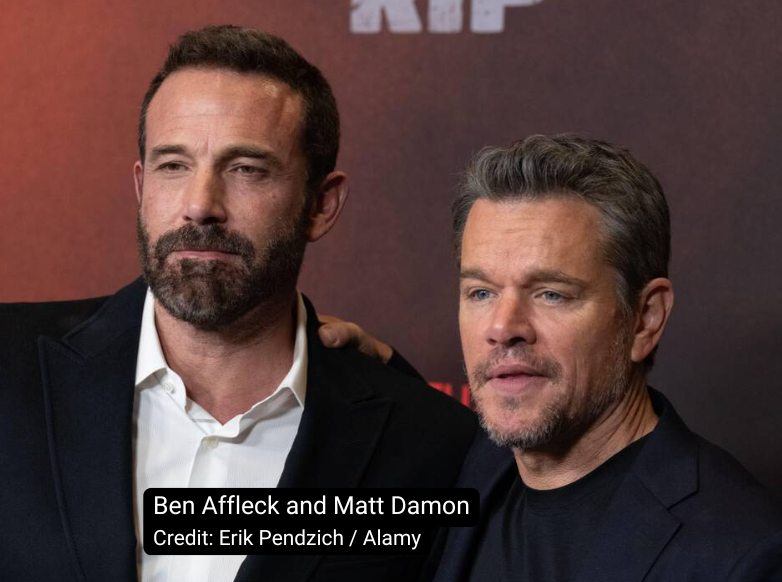
Artists Equity, the production company founded by Hollywood A-listers Matt Damon and Ben Affleck, is being sued by two Miami-Dade law enforcement officers, Jason Smith and Jonathan Santana, over the Netflix crime drama, The Rip. The film was released in early 2026 and stars Affleck and Damon as Miami-Dade officers who uncover corruption relating to $20 million of cartel money.
Smith and Santana’s complaint alleges that the film is based on a real case, in which they seized $21 million. Although not named in the film, the officers argue that, ‘the film’s use of unique, non-generic details of the June 29, 2016, investigation, combined with its Miami-Dade setting and portrayal of a narcotics team, creates a reasonable inference that the officers depicted are Plaintiffs’.
They go on to argue that there are numerous moments in the film in which the characters go beyond typical police procedure, such as a scene in which Affleck’s character kills a federal agent, which has led to family members and colleagues concluding that they carried out the immoral and unlawful acts.
This is not the first time that material labelled as being ‘inspired by true events’, as The Rip was, has led to legal action. Perhaps best known in recent years is Fiona Harvey’s $170 million claim relating to Netflix’s Baby Reindeer, which began with the text, ‘This is a true story’. Like Smith and Santana, Harvey was not named in the programme. However, internet sleuths purportedly identified her as the inspiration for the show. She has denied carrying out the serious acts of her supposed on-screen counterpart.
WCVB News reports that attorneys representing Artists Equity deny the allegations in the original complaint. Nonetheless, it is another salutary tale of the risks that can arise from framing fiction with reality.
If you would like to discuss any issues arising from fact‑based drama, our legal & compliance team has extensive experience in this area and would be very happy to help - please do get in touch.
REGULATION: Ofcom Consultation: new regulatory code for Streamers
On 14 May 2026, Ofcom published a consultation on its proposed Tier 1 Standards Code. The draft code introduces a new regulatory framework for larger video-on-demand (VOD) services - commonly known as streaming services - with the aim of bringing them more closely into line with traditional broadcast regulation.
Until now, UK VOD services have been subject to the statutory on-demand programme service rules (ODPS). These rules focus mainly on areas such as programme sponsorship and product placement, with only limited editorial obligations - for example, prohibitions on terrorist content and material likely to incite violence or hatred. Overall, the ODPS regime is significantly less prescriptive than the requirements imposed on linear television under the Ofcom Broadcasting Code.
In response to changing viewing habits - and the increasing dominance of streaming platforms - the Government has sought to “level the playing field” by extending broadcast-style regulation to the most widely used VOD services. The aim is that audiences receive broadly equivalent protections regardless of how content is accessed.
The Media Act 2024 gives effect to this policy by introducing a new regime for “Tier 1 Services”. When finalised, the Tier 1 Standards Code will apply to VOD services with more than 500,000 average monthly users in the UK, whether based in the UK or overseas, and it is expected to apply to major global platforms such as Netflix, Disney+ and Prime Video. It will also apply to on-demand services provided by public service broadcasters in delivering their public service remit (with the exception of the BBC).
The draft Tier 1 Standards Code is designed to sit alongside, rather than replace, the existing ODPS framework. Tier 1 Services will therefore need to comply with both regimes, with the new Code supplementing rather than duplicating the existing rules.
Substantively, the draft Code imports many of the core editorial principles from the Broadcasting Code. In particular, programmes on Tier 1 Services would be required to ensure due impartiality on matters of political or industrial controversy and matters of current public policy, avoid unjust or unfair treatment of individuals and organisations, and avoid unwarranted infringements of privacy.
This represents a significant shift in the regulatory landscape. Viewers - and individuals or organisations featured in programmes - will be able to complain directly to Ofcom, with the risk of formal breach findings and potential sanctions.
That said, the practical impact may be less dramatic than it appears. Many producers and commissioners already operate to standards broadly equivalent to the Broadcasting Code. In practice, major streamers either apply their own editorial guidelines aligned with Ofcom principles or require compliance with the Broadcasting Code contractually, even where not strictly required as a matter of regulation.
In addition to the substance of the Codes, Ofcom is also consulting on the procedures it will adopt when investigating potential breaches of the Tier 1 Standards Code.
The consultation on the Tier 1 Standards Code closes on 7 August 2026. The final Code is expected to be published in 2027. It will then come into force 12 months after publication, giving providers time to ensure compliance.
What does this mean in practice? For producers and commissioners, the key point is that the direction of travel is now fixed: broadcast-style editorial compliance will apply to the most significant VOD services as a matter of regulation, not just contract.
In practical terms, existing broadcaster-style compliance processes are likely to become standard for Tier 1 streaming content. Areas such as due impartiality, which have been less central for many VOD projects, may require more careful consideration, particularly in factual and documentary programming touching on public policy or controversial issues. There is also likely to be greater scrutiny and a more formalised complaints risk, with Ofcom directly involved rather than issues being dealt with purely at platform level.
For many established producers, however, this will feel more like formalisation than transformation. The key change is not so much what needs to be done, but the regulatory consequences if it is not done properly.
REGULATION: Ofcom partially upholds IOPC complaint against BBC Panorama documentary on Chris Kaba
Ofcom has partially upheld a complaint brought by the Independent Office for Police Conduct (“IOPC”) concerning a BBC Panorama documentary about the fatal shooting of Chris Kaba.
The complaint related to Panorama: The Chris Kaba Shooting, broadcast on BBC One and made available on BBC iPlayer in November 2024. The programme examined the fatal shooting of Mr Kaba by a Metropolitan Police firearms officer in September 2022, the subsequent IOPC homicide investigation, the CPS charging decision, and the murder trial of the officer, which concluded with an acquittal.
The IOPC raised three principal complaints.
First, it objected to comments made by Sal Naseem, a former IOPC regional director, who suggested that the decision to open a homicide investigation was influenced by concerns about potential public disorder. The IOPC argued that this created the misleading impression that the organisation had been pressured into commencing a homicide investigation.
Secondly, the IOPC complained about criticisms made within the programme by former Metropolitan Police Assistant Commissioner Neil Basu and former firearms officer Anthony Long. According to the IOPC, those comments unfairly undermined the organisation’s independence and decision-making.
Thirdly, and most significantly, the IOPC argued that it had not been given a proper and timely opportunity to respond to those criticisms before broadcast. Although the IOPC had provided a statement to the BBC in advance, that statement was not included in the original broadcast and was only added later to the iPlayer version of the programme.
Ofcom upheld the complaint in part.
In relation to Mr Naseem’s contribution, Ofcom found no breach of the Broadcasting Code. It concluded that the BBC had taken reasonable care to ensure that material facts were not presented, omitted or disregarded in a way that resulted in unfairness to the IOPC.
However, Ofcom reached a different conclusion in relation to the criticisms made by Mr Basu and Mr Long, and the BBC’s handling of the IOPC’s response. Ofcom held that those criticisms had the potential materially and adversely to affect viewers’ opinions of the IOPC in a way that was unfair. It further concluded that, in the circumstances, the BBC should have provided the IOPC with an appropriate and timely opportunity to respond before the programme was broadcast and made available on iPlayer.
Ofcom also found that the omission of the IOPC’s statement from the original programme contributed to unfairness. It therefore concluded that the IOPC had been subjected to unjust or unfair treatment contrary to the fairness provisions of the Ofcom Broadcasting Code.
The decision is an important reminder of the limits of editorial discretion in contentious factual programming. Broadcasters are entitled to air strong criticism and robust opinion, including from authoritative contributors. However, where criticism has the potential materially to affect viewers’ opinions of an individual or organisation, fairness obligations may require that those criticised are given a proper and timely opportunity to respond.
Lawyers at ABBAS have extensive experience handling high-profile complaints to media regulators, in particular Ofcom and the ASA. We regularly advise on strategy and tactics, as well as the drafting of submissions, defences and advocacy. Please do get in touch if you would like to discuss how we can assist.
DEFAMATION (US): It Ends with Us … Settling: Lively and Baldoni Settle
After a litany of allegations and counter allegations, a 16-month legal tussle between co-stars, Blake Lively and Justin Baldoni, has settled, shortly before the matter was set to head to trial. Both are claiming the settlement as a victory, although the full agreement remains under wraps.
The pair had been filming an adaptation of Colleen Hoover’s best-selling novel, It Ends with Us. However, in December 2024 Lively filed a sexual harassment claim against Baldoni in California. She subsequently brought a federal claim in New York, suing for harassment, sexual misconduct and a smear campaign calculated to damage her reputation.
Baldoni responded by filing a counterclaim, denying the allegations against him and alleging that Lively and her husband, Ryan Reynolds, as well as their publicist were defaming him through a public smear campaign. In the meantime, Baldoni had also brought a claim against the New York Times for publishing Lively’s allegations.
Each side sought significant damages, far exceeding those which would be awarded by an English court for equivalent causes of action.
At a pre-trial hearing, a judge warned the parties’ teams against running excessive PR campaigns to achieve victory in the court of public opinion.
In the following months, Lively dropped part of her claim against Baldoni and a judge threw out a further significant portion of it. Baldoni’s counterclaim against Lively and Reynolds and the New York Times was also dismissed.
Then, on 4 May 2026, two weeks before the trial date, the parties settled Lively’s outstanding claims in the federal proceedings. Although Deadline notes that no money is said to have passed hands in the settlement, the agreement does not prohibit Lively from pursuing her claim in the Californian courts. So, this may turn out to be a temporary armistice rather than an end to all hostilities.
DEFAMATION (Canada): Fiddler Sues Google Over Sexual Assault Allegation
The award-winning Canadian musician, Ashley MacIsaac, has brought a defamation claim for $1.5 million in damages against Google. The claim stems from Google’s AI Overview function, which generates information from material online to, as its name suggests, provide what purports to be a summary of information on the Internet.
According to MacIsaac’s claim, the AI Overview falsely asserted that he had been convicted of a series of offences including sexual assault, internet luring involving a child, and had been listed on the national sex offender registry.
CBC reports that the musician had a concert cancelled after the AI Overview began making the erroneous accusation; the concert provider subsequently issued an apology to MacIsaac.
According to The Guardian, the AI Overview for MacIsaac now includes the statement, ‘In late 2025 and 2026, he made headlines for taking legal action against Google’.
At the time of writing, there have been no reports of similar generative AI cases before the English courts. However, the UK Jurisdiction Taskforce, chaired by Sir Geoffrey Vos, has suggested that generative AI platforms could be treated as primary or secondary publishers, depending on the extent of their responsibility for the words complained of and their control over the output. Given that such platforms typically exert at least some control over what is generated, they may face difficulty in denying publisher status at common law.
Whether the courts will take the same view remains to be seen. If they do, however, it could open the door to a wave of similar claims - something Google may be reluctant to test.
TV BUSINESS AFFAIRS: Channel 5 New Terms of Trade – three months in
Channel 5 has been commissioning non‑scripted programming under its new Terms of Trade since March 2026. Our experience at ABBAS has been positive. Channel 5 is clearly keen to work within the new framework; the grant of rights is easier to understand; and the route by which Channel 5 can acquire additional “utility” (i.e. further rights or uses of a programme) is more straightforward, with fixed fees for defined packages of rights rather than ad hoc negotiation. Producers are in a stronger position both to recoup deficit financing (the funding gap between the budget and the broadcaster’s licence fee) and to benefit from UK and international exploitation. The contracting process itself has also been smooth and transparent.
The new terms are set out in full in the Channel 5/PACT 2026 Memorandum of Understanding (MoU), published on the PACT (Producers Alliance for Cinema and Television) and Paramount websites. By way of high level summary:
· The primary licence period – the period during which Channel 5 has its main right to show the programme in the UK – has reduced from four to three years.
· The primary rights package comprises 20 linear ‘playweeks’ (the number of weeks a programme can be scheduled on a traditional linear broadcast channel) and unlimited AVOD (advertiser‑funded video on demand), FVOD (free video on demand) and FAST (free ad‑supported streaming TV channels) on Channel 5 secondary services.
· UK exclusivity is simplified: free linear and free streaming for three years; pay platforms – excluding EST (electronic sell‑through), DTO (download to own) and other transactional services – for two years, or one year where the producer provides a minimum defined level of deficit finance. EST/DTO is non‑exclusive from the day after first Channel 5 transmission.
· Channel 5 may acquire additional utility during the licence period through three clearly defined optional packages: additional linear playweeks; free/basic streaming on Channel 5 group services (e.g. Pluto TV and MTV services); and subscription streaming on Channel 5 group services (e.g. Paramount+).
· Further, equally well‑defined packages allow for limited extensions of the licence period.
· These packages are priced as fixed percentages of the Agreed Cost of Production, with Channel 5 responsible for obtaining the necessary clearances. In practice, this gives producers more certainty on what Channel 5 will pay for additional rights, rather than requiring negotiation each time.
· Channel 5 takes no share of distribution revenue outside the Channel 5 territory and has no entitlement in the Channel Territory after the licence period.
· During the Channel 5 licence period, producer deficit funding is recoupable in first position from UK licensing revenue, meaning the producer recovers its funding shortfall before profits are shared.
The shorter exclusivity window against UK and Irish pay platforms, particularly the one‑year position where producers are providing meaningful deficit financing, is an enlightened approach that reflects current commercial realities.
Until a new standard production agreement is agreed, the existing Programme Production Agreement (PPA) remains in use, with a header clause incorporating and prioritising the new MoU. We would always recommend checking that no non‑Terms of Trade provisions creep in and ensuring that Channel 5’s holdbacks (restrictions on when and how content can be exploited elsewhere) and UK branding obligations are properly reflected in distribution agreements. Overall, however, we are enthusiastic about these new terms and believe they will foster a smoother and more transparent contracting process.
ABBAS Media Law has extensive experience advising on Business Affairs and Terms of Trade, and would be very happy to discuss how these changes may apply to your productions - do get in touch.

Abbas Media Law is a boutique law firm, specialising in advice to independent production companies and broadcasters. We are true experts in our field: all lawyers and advisors have in the past worked either in-house for broadcasters and/or production companies.
Accordingly, we fully understand production and the needs of our clients. We offer expert advice and representation on all programme content related matters (legal and regulatory), all aspects of business affairs, as well as complaints-handling and litigation. Visit www.abbasmedialaw.com or contact us directly at info@abbasmedialaw.com.